
TL;DR: Most local retailers already have their inventory in a POS system or spreadsheet. Export it, clean it up, upload it to Google Merchant Centre. Add click-and-collect. When someone searches for a specific product in your area, you appear before the big chains. The infrastructure is free. Regional competitors aren’t doing this yet.
Why Your Stock Isn’t Being Found Online
-
Your inventory lives in your POS system where Google can’t see it
-
Customers search for specific products and find chains instead of you
-
80% of consumers search for local businesses weekly, but you’re invisible
-
The solution: export your stock list, add descriptions and photos, connect to Google
-
Click-and-collect converts digital discovery into local sales
I ask every local retailer the same question when we first sit down.
What’s the one thing you want people to find you for?
They tell me straight away. The main product. The service that pays the bills. The thing that keeps the lights on.
Then I look at their website. I check their Google Business Profile. I search for that exact product in their town.
They’re invisible.
Not because they lack the product. Not because they’re bad at what they do. They’ve got the stock. They’ve got the expertise. They’ve got twenty years of knowing exactly what customers need.
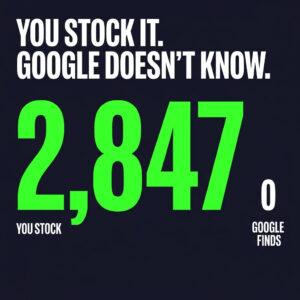
But none of that knowledge exists anywhere Google can find it.
What’s the Gap Between What You Sell and What’s Discoverable?
Here’s what I find almost every time.
The retailer mentions the product once. Maybe twice if I’m lucky. Maybe in a category heading. Maybe buried in a paragraph about “quality hardware supplies” or “comprehensive pet care products.”
But the details? The specific fittings, the brand names, the product variations, the things people actually search for at midnight when their hamster wheel breaks?
None of it’s online. It’s basically hidden away.
I’ll ask: “Where’s your stock list?”
They’ll say: “We’ve got it in our shop, but no one really knows where it is. It’s not online. All of our stuff’s in our shop, but people come in asking, ‘Have you got this? Have you got that?'”
Exactly. Because if it’s not discoverable online, customers assume you don’t have it.
Key Point: If your inventory isn’t online, customers assume you don’t stock what they need. Google can’t show what it doesn’t know exists.
I worked with a pet and hobby shop owner in regional Victoria. He stocks hundreds of products. Customers drive from neighbouring towns to buy from him because he’s got things the big chains don’t carry.
But when someone searched for those products, they found Petbarn. They found the chains. They didn’t find him.
Not because he didn’t have the stock. Because Google didn’t know he had the stock.
Where Does Your Inventory Already Live?
Every business with products has their inventory recorded somewhere.
Sometimes it’s a spreadsheet. Often it’s in accounting software. Most commonly, it’s sitting in a POS system.
Square, Lightspeed, Vend, whatever you’re using to ring up sales at the counter.
That system already knows what you stock. It tracks quantities. It knows prices. It probably even has product codes and supplier information.
You’ve already done the hard work.
The inventory exists. It’s structured. It’s maintained. You update it when stock arrives. You adjust it when things sell out.
But it’s locked inside a system that only you can see.
Bottom Line: Your inventory is already digital and structured in your POS system. You’ve done the hard work. It’s just locked where Google can’t see it.
How to Make Your Inventory Discoverable
The process is straightforward.
Export your inventory as a CSV file. Most POS systems let you do this with a few clicks.
Clean up the data. Make product names clear. Add descriptions if they’re missing. Get decent photos in there.
Upload it to an online catalogue.
If you’re using Square, you can launch a website directly from your POS. The products are already there. You add photos, write descriptions, set up click-and-collect, and you’re live.
I’ve had retailers tell me: “We use our Square website, but like, people don’t really see our products.”
The products exist in the system, but they’re not properly surfaced. Not described. Not photographed. Not connected to Google.
The infrastructure’s there. You’re not using it to make your inventory discoverable.
If you’re on another system, you might need to translate the spreadsheet format. Tools like ChatGPT convert one format to another faster than ever before.
Then you connect it to Google Merchant Centre.
Now when someone in your town searches for a specific product, Google knows you stock it.
The Result: When someone in your town searches for a specific product, Google knows you stock it and shows you in results.
What Changes When Your Inventory Goes Online?
The pet shop owner I mentioned earlier doesn’t sell online. No checkout. No shipping. No e-commerce in the traditional sense.
But his products are listed.
People search at midnight. They find him instead of competitors. They call the next day. They come in and buy.
The online catalogue becomes the discovery mechanism.
He tracks inventory levels, so customers know if something’s in stock before they drive across town. They fill in the contact form or call him. He builds trust over the phone. They buy from him instead of the competitor.
According to research from Soci, 80% of U.S. consumers search for local businesses weekly, and 32% do so daily.
Regional retailers in Ballarat, Albury-Wodonga, Warrnambool, Mount Gambier get consistent chances to intercept purchase intent before customers default to big-box chains.
The Takeaway: Online catalogues become discovery mechanisms. People search at midnight, find you first, then call and buy.
Why Click-and-Collect Locks In Sales
Knowing you have something in stock matters.
Reserving it matters more.
Click-and-collect removes the risk someone drives thirty kilometres to find the product sold out.
According to Australian retail data, click-and-collect sales average 30% to 40% of online sales, with best-in-class retailers pushing upwards of 60%.
Regional retailers who implement this convert most of their digital discovery into local fulfilment.
Here’s what most people miss.
ShopFully’s research shows 78% of Australian consumers will often buy other products when they come to the shop to collect their original online purchase. Twenty-four per cent do so systematically. Fifty-four per cent do so occasionally.
A digital inventory listing generates multiple revenue transactions per customer.
The Multiplier Effect: Digital listings drive foot traffic. Foot traffic generates additional purchases. One online search creates multiple revenue transactions.
How Google Decides Who to Show in Product Searches
When someone in Wagga searches for a car part, Google looks for businesses that mention that part.
First, it checks Google Business Profiles. Who’s listed that product in their catalogue?
Then it checks websites. Who’s written about it? Who’s got it in their inventory feed?
If your information doesn’t exist, you’re not in the running.
If it does exist, Google ranks you based on proximity, reviews, photos, posts, and how much detail you’ve provided.
Most small competitors mention practically nothing online.
I imagine Google calling out into a big empty aircraft hangar. A few businesses are down in the back corner, speaking quietly about what they do.
You want to step up to the front and hold up your list nice and big.
Reality Check: Google wants to show you in search results. You’re just not giving them anything to work with.
Do Big Chains Have This Sorted?
You’d think Bunnings or Petbarn would have every product catalogued online.
They don’t.
Even the big competitors don’t have all their products on the website. The small competitors almost certainly don’t.
That’s your opening.
When you list specific products, write descriptions, add photos, and connect to Google Merchant Centre, you can appear before the chains in product searches.
According to local search forum discussions, inventory feeds definitely seem to impact ranking. If Google knows you have a particular product in stock through that feed, it gives you more visibility when people search for that product.
A Warrnambool hardware shop with specific fittings in their feed can appear before Bunnings in product searches.
Your Opening: Even big chains don’t list all their products online. When you do, you appear before them in specific product searches.
What Does This Infrastructure Cost?
Google Merchant Centre costs nothing.
Some e-commerce platforms charge for feed apps or syncing tools. But Google Merchant Centre itself is completely free.
This removes the cost barrier stopping regional retailers from competing with chains that have dedicated technical teams.
You don’t need a big marketing budget. You don’t need to hire an agency. You need to export your inventory, clean it up, and upload it.
Cost Barrier Removed: Google Merchant Centre is free. You don’t need a marketing budget or agency. Export, clean, upload.
What Advantage Do Local Retailers Have Over Chains?
According to research on local retail economics, local retailers return 52% of their revenue to the local economy, compared to just 14% for national chain retailers.
The community benefit is real.
But it only matters if people can find you.
Digital discoverability plus genuine local presence equals competitive advantage.
You know your customers. You stock products the chains don’t carry. You provide service they can’t match.
The only thing missing is visibility.
Local Advantage: You return 52% of revenue to your local economy versus 14% for chains. You know your customers. You stock unique products. You provide better service. You’re just missing visibility.
Why Regional Areas Have Bigger Opportunities
I’ve worked with businesses across Hong Kong, Melbourne, regional Victoria, New South Wales, Western Australia.
The visibility problem is identical everywhere.
But the opportunity is bigger in regional areas because the competition hasn’t implemented any of this yet.
In Melbourne CBD, professional marketing companies saturate the online space. You’re competing with businesses that have full-time teams managing their digital presence.
In Bendigo, Ballarat, Wagga, Mount Gambier?
You’re often the only one doing it.
Less saturation. Same tools. Fraction of the cost.
Regional Advantage: In cities, you compete with full-time marketing teams. In regional areas, you’re often the only one implementing this. Less competition, same tools, fraction of the cost.
What Should You Do First?
Start with what you already have.
Your inventory exists. Your product knowledge exists. Your operational expertise exists.
It’s locked in your head and hidden in your POS system.
Export it. Clean it. Upload it.
Add click-and-collect so people can reserve products before they drive across town.
Connect it to Google Merchant Centre so your products appear in search results.
When someone in your area searches for a specific fitting, tool, pet product, or piece of equipment at midnight, they’ll find you before the big chains.
That’s the opportunity most local retailers miss.
Not because it’s complicated. Because most retailers don’t know how accessible it is.
If you want to talk through how this works for your business, give me a call. We’ll dig into what you’ve already got and work out the quickest path to making it discoverable.
Frequently Asked Questions
How do I export my inventory from my POS system?
Most POS systems (Square, Lightspeed, Vend) have an export function in settings or reporting. Look for “Export Products” or “Download Inventory.” The file downloads as a CSV spreadsheet.
What if my product data is messy or incomplete?
Clean it up in the spreadsheet before uploading. Make product names clear. Add descriptions if missing. You don’t need perfect data to start. Basic information gets you visible. Improve it over time.
Do I need to sell products online to list them?
No. You don’t need e-commerce or checkout functionality. List your products with accurate stock levels. Add click-and-collect if you want. People find you in search, then call or visit your shop to buy.
How much does Google Merchant Centre cost?
Nothing. Google Merchant Centre is completely free. Some e-commerce platforms charge for feed syncing tools, but the Google infrastructure itself costs zero.
Will this work if I’m competing with Bunnings or big chains?
Yes. Big chains don’t list every product online. When you list specific products with descriptions and photos, you appear in product searches where chains don’t. A regional hardware shop with specific fittings in their feed shows up before Bunnings for those products.
How long does it take to see results?
Google needs time to index your products. Some businesses see search visibility within days. Most see meaningful traffic within weeks. Get your inventory online, then let Google’s algorithms work.
What’s click-and-collect and why does it matter?
Click-and-collect lets customers reserve products online, then pick them up in-store. It removes the risk of driving across town to find something sold out. Australian data shows 30% to 40% of online sales come from click-and-collect. Best retailers hit 60%.
Do I need technical skills to set this up?
No. If you’re running a POS system, you have the skills needed. Export a CSV file. Clean up the data in a spreadsheet. Upload it to your website or Google. The technical barrier is lower than most retailers think.
Key Takeaways
-
Your inventory already exists in digital form in your POS system. Export it, clean it up, and make it discoverable online.
-
80% of consumers search for local businesses weekly. If your products aren’t listed online, customers assume you don’t stock them.
-
Google Merchant Centre is free and removes the cost barrier that prevents regional retailers from competing with chains.
-
Click-and-collect converts 30% to 60% of online discovery into local sales. 78% of customers buy additional products when they collect their order.
-
Regional areas have bigger opportunities because competitors haven’t implemented this yet. Less saturation, same tools, fraction of the cost.
-
Big chains don’t list all their products online. When you do, you appear before them in specific product searches.
-
Local retailers return 52% of revenue to the local economy versus 14% for chains. Digital discoverability combined with local presence creates competitive advantage.