How to Build Customer Trust Online: Say What You Know
Customers and Google trust the business that explains the job. Twenty years of trade knowledge in your head is worth nothing on a website that says 'quality service'. Here is how to build customer trust online by getting what you know onto the page, without writing a word.

By Boostable · 13 September 2026
Websites and SEO for Australian businesses · ~12 min read


Ask a painter with twenty years on the brush why a job fails, and you get a real answer. The prep. Someone skipped the sugar soap, or painted over chalky render, or put the top coat on a wet morning. Ask the same painter's website, and it says "quality workmanship, competitive prices, free quotes".
That gap is the whole problem with how to build customer trust online. The knowledge that makes a customer choose you lives in your head and comes out on the phone, in the ute, at the quote. It never makes it onto the page that customers, and Google, are actually reading at nine o'clock at night when they decide who to call. So the page says what every competitor's page says, and the customer picks on price.
This guide is about closing that gap. What trust actually looks like on a web page according to Google and to the researchers who have measured it, why "we're the best" fails and "here is exactly what we do" works, and how to get twenty years of knowledge out of your head and onto your site without writing a single word yourself.
- The free Google review system: the other half of trust, other people saying it, collected automatically.
- How to write about your business so customers can find you
- Business blogging without the typing
- Google reviews for business: how they drive sales
What trust looks like to Google
Google is unusually open about this. Its guidance on helpful content says its systems look for "experience, expertise, authoritativeness, and trustworthiness, or what we call E-E-A-T", and that of the four, trust is the most important.[1] The guidelines Google gives its own human quality raters say the same in one line: "The most important member at the center of the E-E-A-T family is Trust."[2]
The interesting part is how Google tells raters to judge it. Experience means "the extent to which the content creator has the necessary first-hand or life experience for the topic", and the example Google gives is the one every tradie will recognise: "which would you trust: a product review from someone who has personally used the product or a 'review' by someone who has not?"[2] Expertise is "the necessary knowledge or skill for the topic". Trust is whether "the page is accurate, honest, safe, and reliable".[2]
Google added that first E, experience, in December 2022, and explained why: some content is only valuable when it comes from "someone who has first-hand, life experience on the topic at hand".[3] That is a description of a tradesperson. You have the experience. The question is whether the website shows it.

What trust looks like to a customer
Long before Google wrote E-E-A-T down, Stanford's Persuasive Technology Lab spent three years and more than 4,500 people working out what makes a website believable. The result was ten guidelines, and the first few read like a checklist for a trade website.[5]
Make it easy to verify
Stanford's first guideline. Specific, checkable statements about how you work beat adjectives every time. "We use two coats of oil-based primer on bare timber" can be verified. "Quality work" cannot.
Show a real organisation
The easiest way, Stanford says, is a physical address. A service business can show a base suburb, an ABN and a licence number instead.
Highlight the expertise
Credentials, years on the tools, the specific things you know. This is the guideline most trade sites miss completely.
Show honest people
Real names and real faces. Stanford notes even a line about family or hobbies helps, because it shows a person stands behind the site.
Make it easy to contact you
Phone, address, email, clearly visible. Not a form and nothing else.
Look professional and be useful
People judge a site by its design in seconds, then by whether it answers their question.
Notice how much of that list is about specifics and people, and how little is about slogans. Customers trust what they can check. Google, reading the same page, is trying to work out the same thing.
Put the trust where the customer looks
A customer who lands on a service page from Google does not tour the website. They read that page, glance at the reviews, and either ring or leave. So the trust has to be on the page they land on, not filed away on an About page they never open.
In practice that means every service page carries a short "who does this work" line with a name and a photo, the licence number where the trade has one, a real photo or two from that kind of job, and one review that mentions it. The About page still matters, mostly for Google and for the customer who is comparing three quotes, but it is the second thing read, not the first. Contact details go on every page, in the header and the footer, because Stanford's fifth guideline is the one people test first: can I ring these people?[5]
Why "we're the best" fails and "here is what we do" works
Every trade website says it is the best. Customers know this. It is background noise, the same as "competitive prices" and "no job too small". Because everyone says it and nobody can check it, it carries no information, and a page made of it tells the customer nothing except that you own a website.
Now take the painter. Instead of "quality workmanship", the page says: we wash every exterior with sugar soap before we touch it, because paint over chalk peels within two summers; we prime bare timber twice because the first coat soaks in; we will not top-coat before ten in the morning in winter because the surface is still wet with dew. A customer who has ever had a paint job fail reads that and thinks: this person knows why mine failed. That is trust, built in three sentences, and it is built by specifics.
✓ Builds trust
- "We pressure-test every joint before we close the wall, because a slow leak behind plaster costs more than the whole job"
- "Most gutter failures we see are from silicone joins done in the cold; we rivet and seal, and we come back after the first rain"
- "Here is what a bad stump grind looks like, and here is ours at 300 mm below grade"
- Real photos of real jobs, with the suburb
- The owner's name, face and licence number
- Reviews that mention the job and the suburb
✗ Says nothing
- "Quality workmanship at competitive prices"
- "Customer satisfaction is our number one priority"
- "We use only the best materials"
- Stock photos of a smiling model in a hard hat
- "Our team of professionals"
- "Trusted by thousands"
Google's own self-assessment questions for content ask exactly this. Does the content "clearly demonstrate first-hand expertise and a depth of knowledge"? Is it "written or reviewed by an expert or enthusiast who demonstrably knows the topic well"? Does it "provide original information, reporting, research, or analysis"?[1] The left column answers yes to all three. The right column cannot answer any of them.
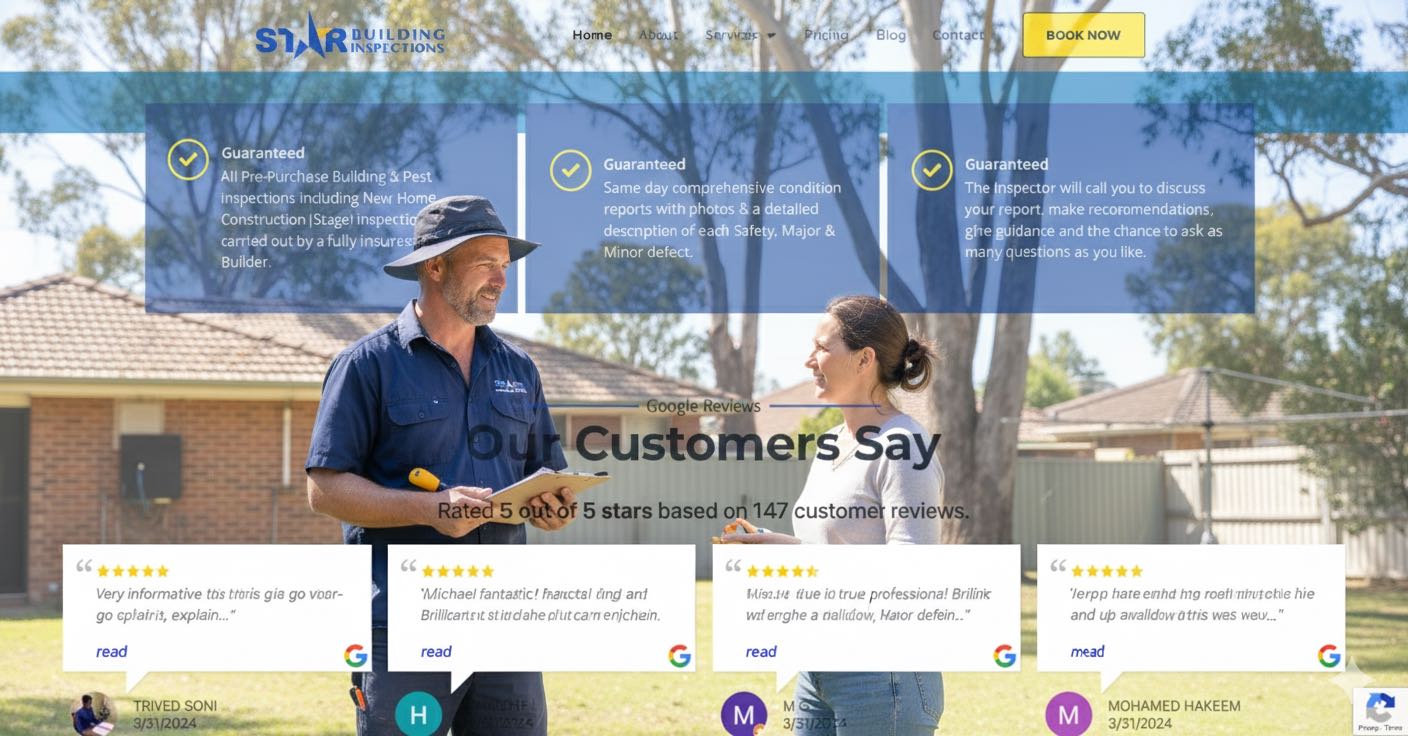
"Thank you so much Tamhas for being so honest, hardworking and proactive on our website and marketing endeavours. Tamhas and the team worked on our catering business website in Melbourne and did a phenomenal job on what was a clunky old site that broke all the time. Look forward to a great working relationship moving forward."
Food Hugs ★★★★★ Verified Google review
The three questions every service page should answer
We have found that the fastest way to turn a generic page into a trusted one is to make it answer three questions about the service, in the owner's own words.
| Question | What the answer contains | What it proves |
|---|---|---|
| What do we do? | The service, every variation of it, who it suits, what it costs roughly | Relevance. Google and the customer can tell this page is about their job |
| How do we do it well? | The steps, the materials, the checks, in order, and why each one matters to the result | Expertise and experience. Only someone who does the job can write this |
| What goes wrong, and how do we stop it? | The common failures in your trade, what cheap operators skip, and the specific thing you do to make sure it never happens on your jobs | Trust. The customer sees you know the risks better than they do |
The third question is the one that does the heavy lifting, and it is the one owners never think to answer, because it feels negative. It is not. A customer choosing a tree lopper is worried about the tree landing on the shed. A page that says "here is how we rig a section over a roof so it cannot swing" speaks directly to the worry. The competitors' pages do not mention the shed at all.
Why AI cannot do this for you, and what it can do
The obvious shortcut is to ask an AI to write the page. Google's position on that is clear and fair. It says "appropriate use of AI or automation is not against our guidelines", and that its systems aim "to reward original, high-quality content" however it is produced.[4] What it will not reward is content generated "with the primary purpose of manipulating ranking".[4]
The problem is not the tool. The problem is what the tool knows. An AI has never pressure-tested a joint or seen render chalk in the sun. Ask it for a plumbing page and it will write the same competent, generic page it writes for every plumber, which is exactly the right column of the table above, only longer. It cannot supply the experience, because it has none. Google added experience to its list for precisely this reason.[3]
What AI is very good at is the typing. Give it a recording of you explaining a job for twenty minutes and it will turn that into clean paragraphs, a list of steps, a set of questions and answers, and a dozen short articles, all in your words with your details. The knowledge is yours. The writing is the tool's. That is the division of labour that works.
Want the other half of trust, real customers saying it for you? The review system that asks is free.
Get the free review systemGetting it out of your head: the interview
Business owners, and tradies especially, know the craft cold and hate writing. So we stopped asking anyone to write. We ask them to talk.
The method is an interview, one service at a time, with plain questions. What is this service, and what are the versions of it you offer? Walk me through a job from the first phone call to the last invoice. What do you do that makes it look good and last? What goes wrong in this trade, and what do you do so it never goes wrong on yours? What do customers always ask? Fifteen to twenty minutes of answers, recorded on a phone, is more usable material than most owners would produce in a month at a keyboard.
It works in any language. Talk in whatever is easiest, the recording gets transcribed and turned into English pages, and the only job left for the owner is to read them and say "yes, that is how we do it" or "no, we changed that". Accuracy is the one thing that needs you. Everything else does not.

One interview, ten pieces of content
The reason this is worth the twenty minutes is what one interview turns into. A single conversation about, say, retaining walls, gives you enough for the retaining wall service page, a page for the suburb where you build most of them, a cost guide, an article on why retaining walls fail, a before-and-after post, a set of frequently asked questions, a Google Business post, a short video script, a follow-up email for quotes, and the words to reply to the next review. Ten pieces, one voice, all specific.
Do this for every service and you have a website that no competitor can copy, because it is made of things only you know. That is what Google means by original content, and it is what a customer means when they say "they seemed to know what they were talking about".
The other half: other people saying it
Everything above is you demonstrating trust. The other half is other people vouching for you, which Google files under authoritativeness and customers file under reviews. Pew Research found that 82 per cent of adults read reviews before buying something for the first time, and 48 per cent say it is often hard to tell whether reviews are truthful.[6] That second number is why the two halves work together: a customer who has just read a specific, expert page about your work reads your reviews and believes them, because the page already convinced them you are real.
"Yesterday restored my faith in technology. Tamhas was so helpfull he is very patient and very good at explaining to the elderly in a professional but caring manner. He was able to talk me through a problem I was having with our Business page on Facebook. Many thanks Tamhas very much appreciated from Sue & Colin Reid Border Collies Glenrowan"
Sue McAllister ★★★★★ Verified Google review
A review like that does three things at once: it names a real person and a real place, it describes a real interaction, and it says "explaining" and "patient", which are the words a nervous customer wants to read. You cannot write it. You can only earn it, and make it easy to leave. The review card at the end of every job is how that happens without anyone having to ask.
- Open your main service page and read it as a customer. Cross out every sentence a competitor could have written. See what is left.
- Pick your most profitable service. Record yourself for twenty minutes answering the three questions: what we do, how we do it well, what goes wrong and how we stop it.
- Have the recording turned into a page. AI can do the typing; you check it for accuracy.
- Add your name, your face, your licence number and your base suburb to the site. Stanford's guidelines two through five, done in an afternoon.
- Put three real job photos on the page, with the suburb in the caption.
- Get the review card into the van so the other half of trust starts building by itself.
- Repeat step two for the next service next week.
The simple truth
You already have the thing that builds customer trust: you know the job, and you know why it goes wrong. The only failure is that it is in your head and not on the page. Google says it is looking for first-hand experience and trust above everything else. Customers say they trust what they can check. Say what you do, say how you do it, say what can go wrong and how you stop it, and let the reviews say the rest.