

Most Australian small businesses can’t rank on Google for the same handful of reasons. They’re not the reasons the SEO industry usually sells. The reasons are simple, fixable, and ranked here in priority order — what to do first, what to do second, what to do tenth. This is the 2026 Boostable SEO checklist for Australian small businesses, in the order that moves rankings fastest.
Why This Matters For Your Business
If your phone isn’t ringing, the work isn’t happening at the level that matters. Most Australian small businesses are losing 60–80% of their potential lead flow because of two or three fixable signals Google can’t see. The checklist below fixes them in the cheapest, fastest order.
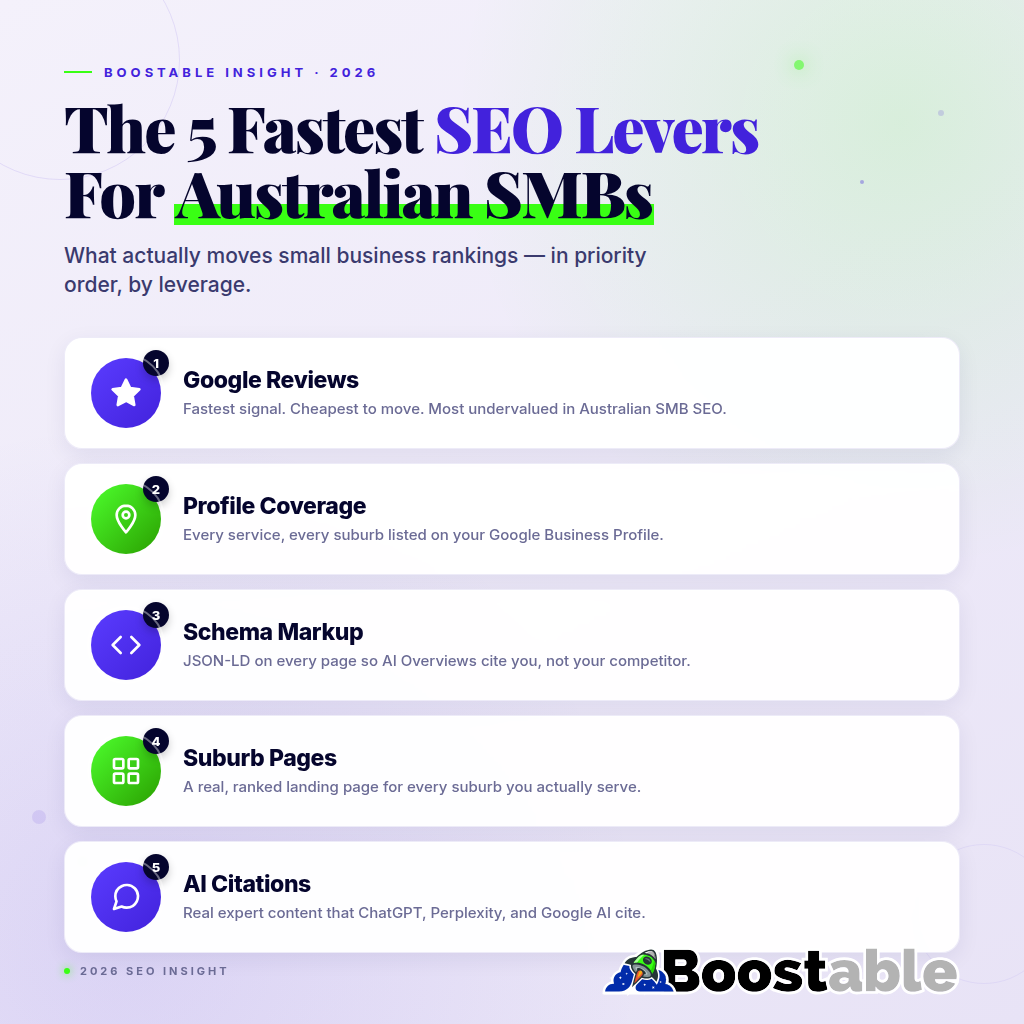
The Checklist
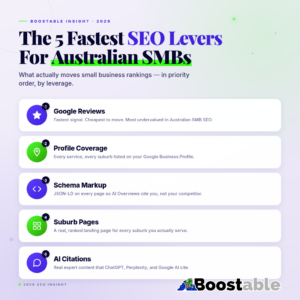
The 5 Fastest SEO Levers, In Priority Order
1. Get the Boostable free Google review system installed
Reviews are the single fastest and cheapest signal you can move. Google’s local pack ranking algorithm weights recent review count, recent review velocity, and average star rating extremely heavily — arguably more than any other on-site signal for local search [1]. Most Australian small businesses sit at 10–30 reviews while their best-ranking competitor sits at 200–800.
What To Do
- Install a branded review request system that fires a follow-up SMS the day after every job or appointment.
- Set a weekly minimum — even 3 new reviews per week compounds to 150 reviews per year.
- Respond to every review within 24 hours. Google reads response activity as a freshness signal.
2. Complete every field on your Google Business Profile
Most Google Business Profiles are 30–50% complete. That includes missing service entries, missing suburb area-served entries, missing product entries, no posts, no Q&A, no photos updated in the last 90 days. Google’s own help documentation [2] states that a complete profile is one of the strongest signals for local pack inclusion. Each field is a separate rank lever and they compound.
Why This Matters
A fully completed Google Business Profile can lift a business from invisible to top-3 local pack in a competitive Australian metro suburb within 4–8 weeks — without changing the website at all. The leverage is huge and the cost is hours, not dollars.
3. Install proper JSON-LD schema markup on every page
Schema markup is the invisible structured-data layer that tells Google, ChatGPT, Perplexity, and Google AI Overviews what a page is about, not just what it says. Schema.org [3] is the universal vocabulary. Independent industry studies of large page samples consistently find that the overwhelming majority of pages on the open web are missing at least one of the recommended schema types for their content type. Without schema, AI search engines have no machine-readable reason to cite your page in an answer box.
What To Do
Add at minimum these schema types site-wide and validate via Google’s Rich Results Test [4]:
Organization+LocalBusiness(site-wide)Serviceon each service pageFAQPageon pages with FAQ blocksBreadcrumbListon every pageArticle+Personon blog posts
4. Build a real page for every suburb you serve
Google ranks pages, not businesses. A plumber serving 30 suburbs needs 30 dedicated pages, each properly built around that suburb’s name, to rank for “plumber {suburb}”. This is not a content farm tactic when each page carries genuine local detail — the suburb’s actual streets you work, the suburb’s actual building styles, the real reviews from customers in that suburb. The pattern of geo-locked content for local services is well established across every major search market [5].
A plumber serving 30 suburbs needs 30 pages. Not one page that mentions 30 suburb names. Google can tell the difference and only rewards the first one.
5. Get cited in Google AI Overviews and AI search results
AI search engines — Google AI Overviews, ChatGPT search, Perplexity, Gemini — are now responsible for an increasing share of high-intent business search queries. Industry coverage from publishers like Search Engine Journal [6] reports AI Overview citations driving substantial lift in click-through-rate for the cited domains. AI search engines cite pages that look like authoritative answers — FAQs, structured lists, schema, expert author bylines.
“I run a small service business. I was not doing well on google. While looking at someone else's website who ranked really high, i found Boostable Web Design & Digital Marketing's logo at the bottom of the page.. so i called Tamhas. From my initial phone call, it was obvious he had full knowledge of local SEO. He was & still is so helpful. He's energetic and is as keen as i am at getting results. The first day i was verified on GMB after he tampered with it, i got a call from a customer that turned into a job the same day. Boostable is well worth the money.”
The Difference
Boostable Approach vs The Typical SEO Retainer
“Tamhas designed our website and did seo for us and has provided us with so much work and quality leads. We are so grateful for the work Tamhas did. He has been a massive help in building our business. I would highly recommend.”
Your 30 Day Priority Order
- Week 1: Install a branded review request system. Send the first SMS round.
- Week 2: Complete every field on your Google Business Profile. Every service. Every suburb. Every product. Recent photos.
- Week 3: Audit your site for schema markup. Add Organization, LocalBusiness, Service, FAQPage. Validate via Google Rich Results Test.
- Week 4: Plan your suburb page build. One page per suburb you actually serve. Real photos. Real local detail.
Start With Reviews
Get started today on the path to being the number one business in your niche and your area.
Our proven double-step Google review system is yours to keep, free. Reviews start landing inside week one — the cheapest and fastest signal Google reads for local rank.
Get our free review system →Frequently Asked Questions
Australian Small Business SEO Questions Answered
What is the single most undervalued SEO lever in 2026? +
Google Reviews. The volume of recent positive reviews on a Google Business Profile is the highest-leverage signal for local pack ranking and the cheapest signal to move. Most Australian small businesses sit at 10–30 reviews while top competitors sit at 200–800. Closing that gap moves rankings inside weeks, not months.
How important is schema markup for AI search engines? +
Critical. Google AI Overviews, ChatGPT search, and Perplexity all weight pages with valid JSON-LD schema markup higher when deciding which content to cite in answer boxes. A page with no schema is, to an AI, an unsigned document — there is no reason to quote it.
Do we need a separate page for every suburb we serve? +
For local services, yes. Google ranks pages, not businesses. A plumber serving 30 suburbs needs 30 pages each properly built for one suburb to rank for “plumber {suburb}”. Tradies, salons, real estate, allied health all benefit from suburb-page coverage.
How long does it take to see SEO results in 2026? +
Reviews and Google Business Profile changes can move rankings inside 2–4 weeks. New pages typically take 6–12 weeks to rank, and another 3–6 months to compound into significant lead-flow growth. Anyone promising overnight results is selling fiction.
Is content length still important for SEO? +
Length itself is not. Matching the median word count of the pages currently ranking for your target keyword IS important. Pad past that range and you hurt yourself. Some queries reward 1,500-word pages, some reward 3,000. Match what is ranking — no more, no less.
What is the most common SEO mistake Australian small businesses make? +
Spending money on SEO retainers before fixing reviews and Google Business Profile. The first two levers cost almost nothing and move rankings the fastest. Skipping them for paid content production is the most expensive mistake in Australian small business SEO.
Sources & Further Reading
- Search Engine Journal. Google Business Profile and Local SEO ranking factors. searchenginejournal.com
- Google Business Profile Help Center. How to improve your local ranking on Google. support.google.com/business
- Schema.org. The structured data vocabulary used by Google, Microsoft, Yahoo!, Yandex. schema.org
- Google Search Central. Rich Results Test — the official structured data validator. search.google.com/test/rich-results
- Google Search Central. Local business structured data guidance. developers.google.com/search
- Search Engine Land. AI Overviews and how they affect click-through rates. searchengineland.com
Tamhas started building websites for small Australian businesses in 2008 — and for increasingly larger businesses since 2012. The Boostable SEO method is built around three pillars: a free Google review system on day one, a strategically deep Google Business Profile, and high-impact landing pages for every commercial keyword your customers type when they’re looking for the products and services you provide.