



I ask every client the same question when they want to sell online.
What’s the main thing you want people to find you for?
They tell me straight away. Usually it’s a specific product or service category. Something they’ve built their reputation on.
Then we look at their website or Google Maps listing.
The thing they want to be known for barely gets mentioned. Maybe the product name appears once. No details. No descriptions. Nothing that tells Google or a customer why they should care.
This happens in Ballarat, Toowoomba, Cairns, Warrnambool, and Albury-Wodonga. It happens in Melbourne CBD too. The gap between what business owners want to sell and what’s actually discoverable online is massive.
The problem isn’t awareness. They know the gap exists.
The problem is they think fixing it will be expensive and complicated.
Why Businesses Choose Shopify Then Switch to Something Simpler
Shopify looks like the obvious choice. Everyone talks about it. The marketing is everywhere. It promises everything you need to run an online store.
Then you start using it.
You realise you need apps for everything. One for bookings. Another for loyalty programmes. A different one for inventory if you sell in person. Each app has its own login, its own dashboard, its own monthly fee.
Character.com ran thousands of products on Adobe Commerce. They had integrations everywhere. Content management became exhausting. They migrated to Shopify and conversions increased 40%.
The simpler system won.
This pattern repeats constantly. Businesses try the platform everyone recommends. They spend weeks setting it up. Then they realise they’re spending more time managing the system than running their business.
Dollar Shave Club decreased technology maintenance resources by 40% after migrating from custom infrastructure to Shopify. They stopped playing defence and started building their roadmap.
Complexity doesn’t create better outcomes. It creates maintenance overhead.
The Framework: Match System Complexity to Operational Reality
You don’t need the most powerful system. You need the system that matches how you actually work.
Here’s my decision framework.
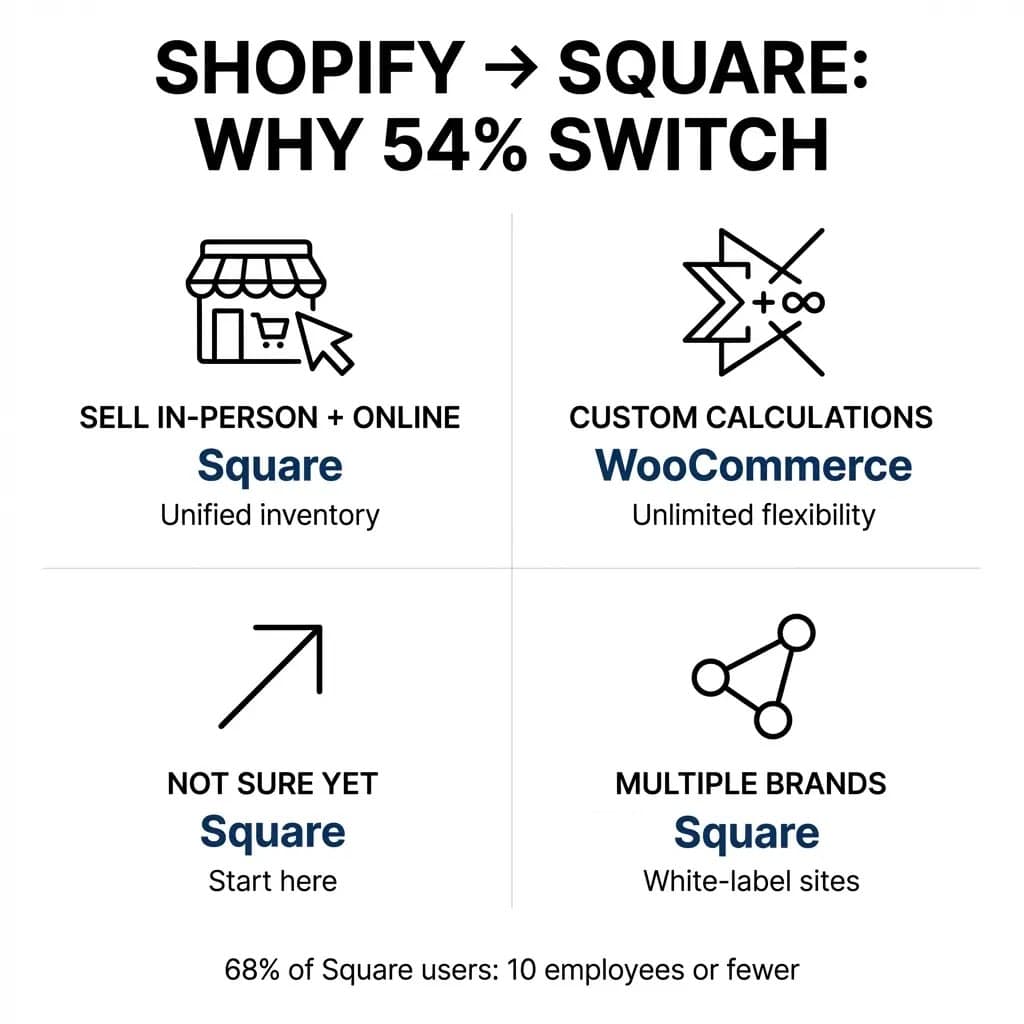
If you sell in person and online, you need unified inventory. When someone buys a product at the counter, your online stock count should update automatically. When someone orders online for pickup, you need to know it’s reserved.
Square does this without additional apps or integrations.
You’ve got your POS hardware. Your online store. Your appointment bookings. Your table reservations. All connected to the same inventory system.
If you need custom calculations or complex ordering logic, you need WooCommerce. Maybe you charge based on weight plus distance. Maybe you offer bulk discounts that change based on customer type. Maybe you need custom fields that don’t exist in standard platforms.
WooCommerce gives you unlimited customisation through plugins. If a plugin doesn’t exist, you can build it.
If you’re not sure, start with Square. You can always add WooCommerce later if you need it. They sync together through inventory management tools.
The key insight: seller cohorts that adopt Square’s full ecosystem see approximately 9% higher sales than those who don’t. Integration drives outcomes more than feature lists.
What Regional Businesses Get Wrong About E-Commerce
The visibility problem is identical whether you’re in Bendigo or Melbourne CBD.
The opportunity is actually bigger in regional areas.
Here’s why.
In Melbourne CBD, every business has hired marketing companies. The online space is saturated. You’re competing against businesses with dedicated teams managing their digital presence.
In Ballarat or Toowoomba, most businesses haven’t implemented basic discoverability infrastructure.
They have products in their POS system. They have operational knowledge in their heads. They have photos on their phones.
None of it exists online.
When someone in Wagga Wagga searches for a specific car part at midnight, Google looks for businesses that mention that part in their Google Maps listing or website.
Most competitors don’t mention it. They assume people know what they stock. They think their reputation speaks for itself.
Google can’t read your reputation. Google reads your content.
I worked with a pet and hobby shop that doesn’t sell online. He just wanted his inventory visible so people could see what he stocks before driving across town.
We listed his products on his website. He keeps the stock levels updated.
Now when someone searches for a specific product at midnight, they find him instead of a competitor. They call the next day. They come in and buy.
The online catalogue became the discovery mechanism.
The Square Advantage for Local Operators
Square solves the integration problem that destroys most e-commerce implementations.
You’re running a cafe in Warrnambool. You take orders at the counter. You want online ordering for pickup and delivery. You want to track which products sell best. You want to message customers with specials.
With most platforms, you need separate systems for each function. Your POS doesn’t talk to your online store. Your loyalty programme lives in a different app. Your inventory exists in three places and never matches.
Square connects everything.
Your products live in one place. When you sell something at the counter, online stock updates. When someone books a table, it shows in the same system where you process payments. When you want to message customers, you’re using the same platform that tracks their purchase history.
68% of Square users are businesses with 10 employees or fewer. 34% have just a single employee. The platform serves exactly the operational scale where complexity becomes destructive.
Square’s next-generation unified POS app drove feature discovery and usage among new sellers up nearly 80% compared to their previous fragmented experience.
Consolidation improves adoption. Fragmentation kills it.
The Real Timeline: Spreadsheet to Live Online Catalogue
Most businesses already have their inventory digital.
It’s in their POS system. It’s in their accounting software. It’s in a spreadsheet.
They think getting it online will take months. They think they need to hire developers. They think they need professional product photography before they can start.
Here’s the actual process.
If you’re using Square POS: Export your products. Add descriptions. Take photos with your phone. Upload them to Square. Turn on your online store. Configure pickup and delivery options.
Time investment: a few focused sessions.
If you’re using another POS system: Export to CSV. Use ChatGPT to translate the format to Square’s requirements. Import. Add descriptions and photos. Launch.
The photos don’t need to be perfect. People know what most products look like. They just want to confirm you have it in stock before they drive across town.
Think of an old restaurant menu without photos. People ordered fine. They knew what the dishes were.
Having your products listed with no photos beats having beautiful photos of products that aren’t listed at all.
⚠️ Important: You still need to configure shipping prices, delivery zones, and pickup options properly. It’s not hard. It just takes working through the settings methodically.
When WooCommerce Makes Sense
I recommend Square for most local businesses.
Sometimes you need WooCommerce instead.
A catering business needs complex pricing calculations for their main operations. Different client types. Volume discounts. Custom delivery zones. Embedded tools that calculate costs based on multiple variables.
Square couldn’t handle those custom requirements. WooCommerce could.
We built their main site on WooCommerce—custom plugins and embedded tools to handle the complex pricing logic their business requires. WooCommerce syncs with their Square inventory so everything stays connected.
Then they wanted to offer catering to schools, funeral homes, and sporting clubs. Each client wanted their own branded website to show their retail customers or members. Simple ordering. Custom feel.
Square is perfect for this. The products already exist in Square inventory. You just spin up a new Square online store. Choose which products from your inventory to display. Put it on a subdomain or custom domain for that client. Done.
When a school’s families order catering through the school’s branded Square site, it looks like the school’s service. When funeral home families order, it’s the funeral home’s offering. All orders process through the same Square system. Same inventory. Same payment processing.
The speed difference is massive. If your products are already in Square POS or Square inventory, launching a new branded storefront takes hours, not weeks. You’re not rebuilding custom functionality. You’re just selecting products and configuring branding.
The framework is simple: Use WooCommerce when you need custom calculations, complex logic, or specific functionality that doesn’t exist in standard platforms. Use Square when you need speed and simplicity—especially for multiple storefronts sharing the same inventory.
They can coexist. WooCommerce syncs with Square through inventory management tools. You can run most of your business on Square and use WooCommerce for the specific use case that needs customisation.
The Google Maps Layer Most Businesses Ignore
Your website matters. Your Google Maps listing matters more for local search.
When someone searches for a product in Wollongong, Google shows them businesses in Wollongong that mention that product.
Google checks your Google Maps listing first. Then your website.
Most businesses have basic information in Google Maps. Business name. Address. Phone number. Maybe a few photos.
They don’t list their products. They don’t describe their services in detail. They don’t post updates about what they stock.
Google can’t show you for searches when you haven’t told Google what you sell.
The ranking factors are straightforward.
Proximity: How close are you to the person searching?
Reviews: How many reviews do you have? How recent? How good?
Content: Do you mention the specific product or service they’re searching for?
Activity: How many photos have you posted? How many updates? How many posts?
You control everything except proximity.
Start with your product list. Put every product category in your Google Maps description. Then create posts about specific products. Add photos of your inventory. Update your services list.
This isn’t sophisticated marketing. This is basic discoverability infrastructure.
The Wholesaler Model: Branded Mini-Sites
Wholesalers face a specific problem.
They want their retail customers to promote their products. But retailers don’t want to send customers directly to the wholesaler’s website. They don’t want customers to discover the wholesale price. They don’t want to risk losing the relationship.
Paper catalogues solve part of this. But they’re static. They don’t update when inventory changes. They don’t include all the product photos and descriptions that exist digitally.
The solution: branded mini-sites.
The wholesaler maintains the master inventory. Product photos. Descriptions. Pricing. Stock levels.
Each retailer gets their own branded storefront. Same products. Same inventory. Their own domain or subdomain. Their own branding.
When a customer orders through the retailer’s mini-site, the wholesaler sees which retailer the order came from. The retailer gets their cut. The customer sees a seamless experience.
I built this for a window dressings wholesaler as installable web apps. Now rolling it out for catering businesses whose clients want to offer catering to their own customers.
The technical setup uses Square or WooCommerce depending on complexity requirements. The inventory syncs across all storefronts. The retailer manages nothing except their customer relationships.
This model works when the wholesaler has strong digital infrastructure and the retailers don’t. The wholesaler provides the technology. The retailers provide the customer access.
What Actually Stops People From Getting This Done
The resistance isn’t to the idea. It’s to the perceived complexity and cost.
Business owners know they need better online presence. They know their products should be discoverable. They know competitors who do this properly get more business.
They think it will take months and cost thousands.
The first unlock is the interview.
Sit down and talk about your business. What you sell. Who you sell to. What makes your offering different. What questions customers ask. What problems you solve.
Most business owners have never had someone systematically ask them these questions. The knowledge exists in their heads. It’s never been organised or documented.
The interview extracts it. Once it’s extracted, you can turn it into website content, Google Maps descriptions, product listings, and blog posts.
The second unlock is realising your inventory already exists digitally.
You’re not starting from zero. You’ve got products in your POS system. You’ve got photos on your phone. You’ve got descriptions you use when talking to customers.
The work is organising and uploading, not creating from scratch.
⚠️ Reality check: 54% of Australian business leaders report skills constraints as the greatest barrier to technology uptake. The concern is staff capability to use new technology and adjust to new processes.
The technology isn’t the problem. The implementation process is the problem.
The Capacity Question You Need to Answer First
Before you improve discoverability, answer one question.
Can you handle more customers?
If you’re already at capacity, increased visibility creates operational problems instead of revenue growth.
You get more enquiries you can’t respond to. More orders you can’t fulfil. More appointments you can’t accommodate.
Your service quality drops. Your reviews get worse. The increased visibility damages your reputation instead of building it.
I don’t work with businesses at maximum capacity. The work creates harm instead of value.
If you’re at capacity, the priority is operational expansion or hiring. Get that sorted first. Then improve discoverability.
If you have capacity and you’re not getting enough customers, discoverability infrastructure solves a real problem.
The Infrastructure Hierarchy That Determines Everything
Foundational infrastructure determines all downstream outcomes.
You can’t optimise content that doesn’t exist. You can’t improve conversion rates on a slow website. You can’t expand to new channels when your core system is fragmented.
The hierarchy is fixed.
Foundation: Server performance. Mobile optimisation. Content extraction from your operational knowledge.
Second layer: Review accumulation. Product listings. Service descriptions. Google Maps optimisation.
Third layer: Content optimisation. Channel expansion. Advanced features.
Most businesses try to start at layer three. They want Google Ads or social media marketing or sophisticated email campaigns.
None of it works when the foundation doesn’t exist.
Average shopping cart abandonment rates sit around 70% across global e-commerce transactions. 21% abandon specifically because of complicated or lengthy checkout experiences.
Technical sophistication that creates friction destroys revenue.
Start with the foundation. Get your products online. Get your services described. Get your reviews accumulating. Get your site loading fast on mobile.
Then optimise.
Why I Built This Way of Working
I noticed a pattern in my own behaviour.
When I needed a service in my area, I searched Google. I looked at the businesses that appeared. I checked their reviews. I looked at their photos. I read their service descriptions.
The businesses with more reviews, better photos, and specific content got my enquiry. The businesses with generic websites and no reviews didn’t.
Then I started working with local businesses. I saw capable operators with years of experience who were invisible online.
They had expertise. They had operational knowledge. They had satisfied customers.
None of it was discoverable.
The gap wasn’t capability. The gap was externalisation.
Technical implementers couldn’t extract content from domain experts. Content creators couldn’t handle technical integration. The disconnection was permanent.
I built the capability to do both. Extract operational knowledge through structured interviews. Implement the technical infrastructure to make it discoverable.
The combination is rare. Most specialists stay in their domain. Full-stack technical capability plus content extraction methodology eliminates the multi-vendor dependency that kills most implementations.
What to Do Next
Start with the diagnostic question.
What’s the main thing you want people to find you for?
Then check if that thing is actually discoverable. Search for it yourself. See what appears. Look at your Google Maps listing. Look at your website.
If the gap is massive, you know what needs fixing.
The best system is the one you’ll actually use. For a cafe in Warrnambool or a boutique in Albury-Wodonga, that’s almost never the complicated option.
Square unifies POS, online store, appointment bookings, table reservations, and inventory in one place. For most local businesses, that’s the right answer.
If you need something custom, WooCommerce gives you unlimited flexibility.
The technology exists. The opportunity exists. The question is whether you’re ready to get your operational knowledge out of your head and onto the internet where people can find it.
If you want to talk through your specific situation, I run these diagnostic conversations regularly. We dig into what you do, what you want to be known for, and what’s actually stopping people from finding you.
The first unlock is usually just having the conversation.
