



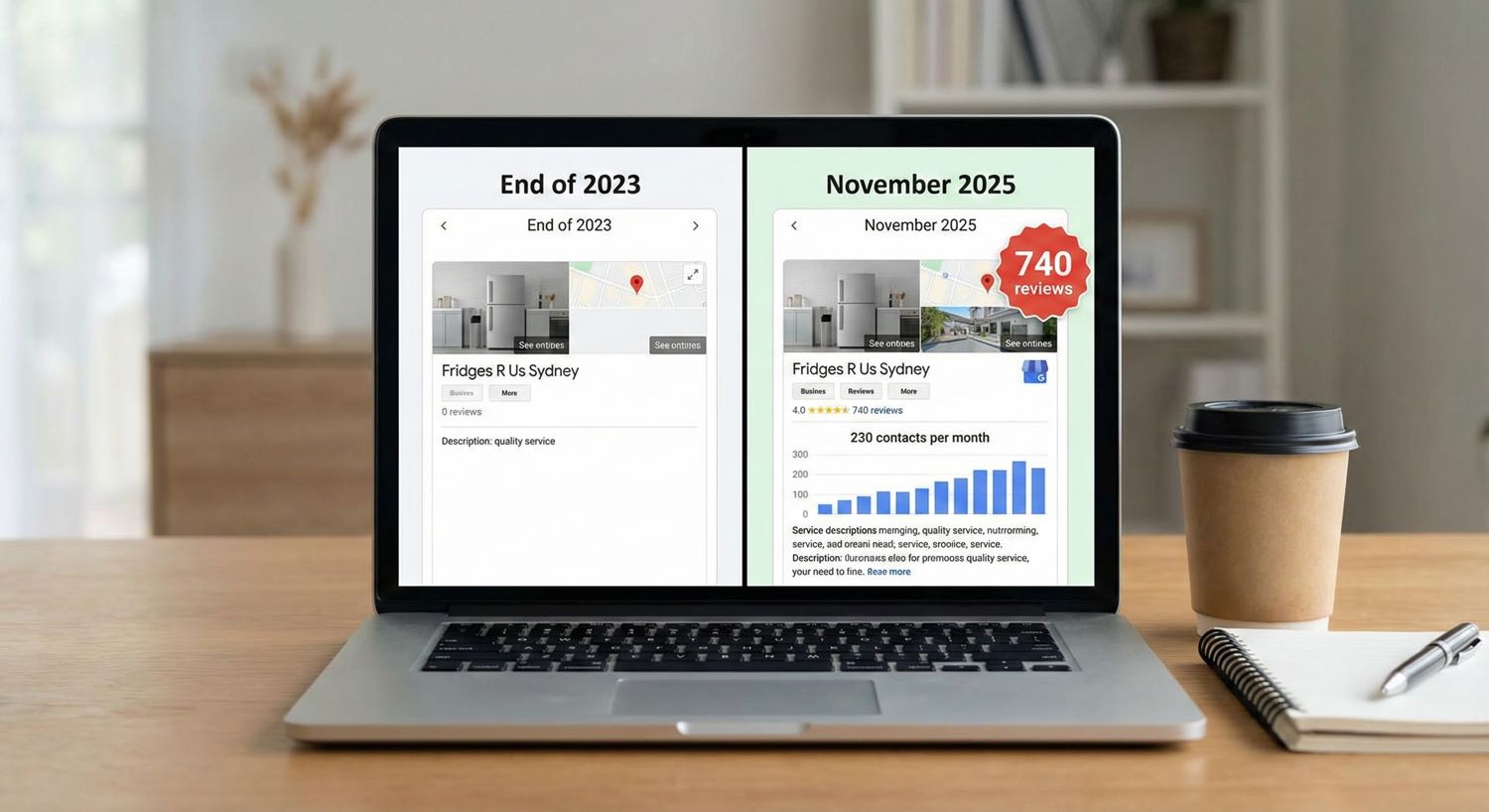
Danny at Fridges R Us Sydney didn’t have a Google Business Profile until the end of 2023.
He was paying serious money for Google Ads. Getting leads. But leaving the most powerful local marketing tool completely untouched.
By November 2025, he had 740 reviews and was getting 230 contacts per month from Google Maps alone. That’s 1,000 people in six months who either clicked his listing or rang him directly.
The cost per lead? Almost nothing compared to what he’d been paying before.
The Pattern I See in Every Audit
I’ve been building websites since 2008. Went full-time with Boostable in 2021 after moving back to Australia from Hong Kong.
The pattern never changes.
I open a business’s Google Maps listing. Empty service fields. Five reviews collected over ten years. A description that says “quality service” and nothing else.
Then I look at their website. Generic copy that could describe anyone in their industry. No mention of how they actually help customers. No detail about what makes them different.
The knowledge exists in their head. It’s just never made it onto their website or Google Maps.
Why Questionnaires Fail and Conversations Work
Most web designers send a questionnaire. The business owner stares at blank fields asking “What makes your business unique?” and types something vague.
They’re not writers. They’re electricians, tree surgeons, caterers. They can talk about their business brilliantly when a customer asks. But writing it down? That’s different.
I realised this early when I’d search for restaurants on Google Maps. I’d scroll through listings, click into photos, check reviews. If the food looked good and the rating was solid, we’d go.
I was doing it. Everyone else was doing it. And it wasn’t just restaurants.
So I changed our process. We interview clients. Record everything. Ask follow-up questions. Dig into the details that matter.
Before AI, we’d transcribe recordings manually and edit them into website content. Now our Boostable Content AI system speeds that up, but the human conversation is still the core.
Because details are what customers actually trust.
The Two-Tier Visibility System
Getting found online works in two tiers.
Tier one: You tell Google everything you do through service fields, categories, and content. If you don’t mention a service, you’re not even in the running when someone searches for it.
You could have a million five-star reviews. But if you’ve never mentioned “emergency electrical repairs” in your Google Maps or website, Google won’t show you when someone searches for that.
Tier two: What customers say in reviews. This matters ten times more than what you say about yourself.
When you search Google Maps, you see review snippets with keywords highlighted. Google uses what customers mention in reviews to match you to searches.
Most businesses fail at tier one. They never document what they do properly. So tier two can’t help them.
The Review Collection System That Actually Works
Apps Tree Removal had zero reviews when we started. He was buying leads from Hipages because he had no Google Maps presence.
We set up his Google Maps. Created a single-page website. Then gave him two simple tools.
Tool one: A business card with a QR code on the back. When he arrives at a job, he hands it to the customer. “Here’s my card with my details. On the back is a QR code. If you scan that, you can leave us a review if you want to say what you thought of our service.”
This plants the idea early. The customer pays attention to the work because they know a review is coming.
Tool two: An SMS template. At the end of the job, when the customer thanks him, he says: “No worries, mate. I’ll send you my Google Review link. If you want to thank us, that’s the best thing you can do.”
The SMS explains what to expect when they click the link. It mentions they’ll need to log into Google if they’re not already. It suggests what they might say in the review.
Most businesses don’t get reviews because they don’t ask. Or they feel like they’re begging.
This system removes that friction. You’re giving customers an easy way to say thank you.
What Happened to Gary at Trim Your Trees
Gary’s Google listing was dead when we found him. He’d shut it down during a business reset.
We recovered it. Reinstated it. Filled in all the right information. Set it to his correct location.
This was June 2024. He had maybe five reviews from ten years in business.
By September, he had 54 reviews.
Same pattern as Apps Tree Removal. Same pattern as Southside Stump Grinding, who went from 100 reviews to 500 in two years.
The system is simple. Hand out the card. Send the SMS. Make it easy.
Why Location Pages Changed Everything for Apps Tree Removal
Apps Tree Removal was ranking well in southwestern Melbourne. Hoppers Crossing, Point Cook, Wyndham Vale, Werribee.
Then we built location pages for him. Unique content for each suburb and service combination.
November 2025: 45 leads in one month with no paid ads.
Now he ranks across almost all of western Melbourne. Not just the southwest. North, northwest, much larger coverage.
Google sees he has dedicated pages for specific locations and services. When someone in those areas searches, he appears in the Maps box because he’s also ranking at the top of regular search results for that location.
Location pages work because they tell Google: “I specifically serve this area for this service.” Not just a vague service area setting.
The Economics of Content That Appreciates
Paid ads stop the moment you stop paying. The tap switches off.
Content gets more valuable over time. The longer it exists, the more backlinks it collects, the higher it ranks. More traffic comes to it. More leads arrive through it.
I’m not saying don’t use paid ads. They’re excellent as a booster, especially whilst you build SEO.
But content is an asset that appreciates. Ads are attention you rent.
One client paid us £10,000 for a website, location pages, and a year of Google Maps optimisation. First year: 600 leads. That’s £16.66 per lead.
Second year: he only paid our hosting and ongoing optimisation fee of £300 per month. Same 600 leads. Now it’s £6 per lead.
The content kept working. The investment kept paying.
What AI Search Means for Businesses Without Content
In my household, ChatGPT gets used as much as Google now. Maybe more.
AI search is accelerating rapidly. And it works the same way Google does.
If the information doesn’t exist, AI can’t find it. If you haven’t mentioned what you do and where you do it, AI won’t recommend you when someone in your area searches for your services.
They’ll recommend your competitor instead.
You need content in your website and Google Maps. But also in strategic places around the web. Reddit, industry forums, review platforms.
Competence without communication is invisible. Doesn’t matter how good you are if nobody knows.
The Invisible Fields That Determine Visible Results
Google Maps has fields most business owners never see. Service fields. Category fields. Description fields for each service.
Customers can’t always see these on the front of your listing. But they determine what you get found for.
If you’ve only listed one suburb in your service area, Google assumes you only serve that suburb. Someone in the next suburb over searches for your service? Google won’t show you.
You could have brilliant reviews and detailed content. But Google’s following what you told it: you don’t serve that area.
We use tools to find every relevant category for a business. We fill in every service field. We make sure the location settings are correct.
These invisible fields determine whether you’re even in the running for a search.
The Biggest Mistake After Launch
You set up your website. Fill in your Google Maps. Get some reviews.
Then you stop.
Your competitors don’t stop. Younger businesses figure out they should be filling in their Google Maps properly. They start collecting reviews. They create detailed content about what they do.
Suddenly they’re ranking higher than you. Getting the lion’s share of local leads.
You don’t have to outrun the tiger. You just have to outrun your mate.
If you’re in an industry where most businesses don’t do the right things, you only need to do slightly better to rank high.
But “slightly better” requires consistent attention. Not a one-time project.
Post to your Google Maps three times a week. Add photos from jobs. Write blog posts targeting long-tail keywords your competitors ignore.
Everyone’s fighting for the top 30 keywords. We help clients rank for the hundreds of other keywords that get 30, 40, 50 searches per month.
Seven blog posts in a week, each ranking for a keyword with 50 monthly searches? That’s 350 extra searches per month you’re capturing that competitors aren’t.
What This Actually Takes
I’m not going to tell you this is easy. It’s not complicated, but it requires work.
You need to extract the knowledge from your head. Document what you do, where you do it, how you help customers avoid problems.
You need to fill in your Google Maps properly. All the categories. All the services. All the descriptions.
You need to ask every customer for a review. Hand them the card. Send them the SMS. Make it part of your process.
You need to keep posting. Keep adding photos. Keep creating content.
Most businesses won’t do this. They’ll set things up once and wonder why it’s not working six months later.
The ones who do this work? They dominate their local area.
Danny at Fridges R Us Sydney is getting 230 contacts per month from Google Maps. Apps Tree Removal got 45 leads in November with no paid ads. Gary at Trim Your Trees went from five reviews in ten years to 54 in three months.
They’re not special. They’re not in unique industries. They just did the work most businesses won’t do.
That’s the difference between being found and being invisible.
